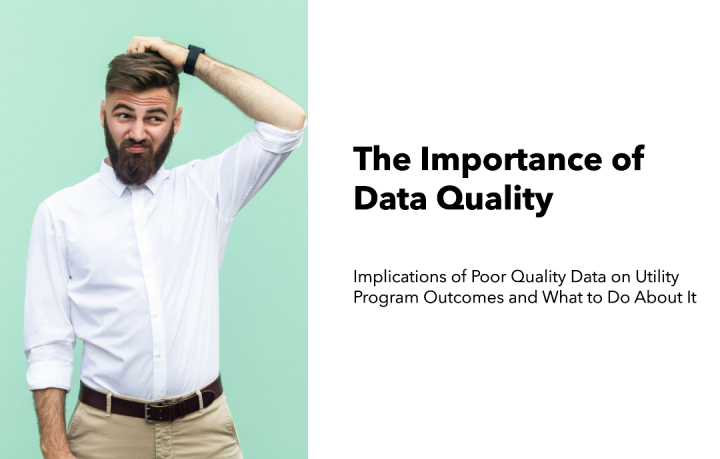
Today’s grid – and the programs utilities rely on to effectively manage it – are more connected and data-driven than ever before. Many utilities partner with outside solution providers to help them identify and implement key elements of their customer demand management strategies. However, poor quality data can hamper these efforts by making it more difficult to effectively measure and track program results. In this article, we’ll explore the implications of poor quality data and discuss strategies for enhancing data quality and results validation.
Not having complete and reliable data causes a variety of problems. It’s important to recognize that the effectiveness of programs relies heavily on the quality of the input data. Poor quality data can lead to inaccurate insights, hindering utilities’ ability to make well informed decisions. Utilities may also experience operational inefficiencies, delays, and increased costs. And for those utilities subject to strict regulation, poor data quality can even result in non-compliance, leading to fines and reputational damage. Vendors need to ensure that their programs contribute to, rather than compromise, regulatory adherence.
Fortunately, there are proven ways to improve and ensure data quality and validation of program results:
1. Data Standardization
Vendors should collaborate with utilities while participating in and contributing to industry standards committees and organizations to develop and improve standard data protocols. This ensures that data is consistently formatted, handled and communicated, which increases reliability and makes it easier to identify and rectify errors when they occur.
2. Data Cleansing and Validation
Implementing robust data cleansing and validation tools can help vendors identify and rectify errors in real-time. These tools can automatically validate incoming data, flagging any anomalies for immediate attention.
3. Collaborative Data Governance
Establishing a collaborative data governance framework between vendors and utilities fosters a shared responsibility for data quality. Regular communication and feedback loops can help identify and address issues promptly.
4. User Training and Awareness
Vendors should provide comprehensive training to utility staff on data entry protocols and the importance of data quality. Increasing awareness among users can significantly contribute to the overall improvement of data reliability.
5. Continuous Monitoring and Auditing
Implementing continuous monitoring and auditing processes can help vendors identify and rectify data quality issues proactively. Regular audits ensure that data quality standards are consistently met.
6. Integration of Data Quality Metrics
Embedding data quality metrics within the program can provide immediate feedback on the quality of incoming data. Vendors can use these metrics to assess and improve data quality continuously.
7. Adopting Advanced Analytics and Machine Learning
Leveraging advanced analytics and machine learning algorithms can help vendors identify patterns and anomalies in data, allowing for predictive measures to enhance data quality.
By proactively implementing these strategies to ensure data quality, utilities can significantly enhance the reliability and impact of their programs. This not only ensures optimal utility operations but also will also improve decision-making and compliance with regulatory requirements. In a rapidly evolving energy landscape, a commitment to high-quality data is the foundation to the success and sustainability of utility programs.